Your Net Worth Is an Opinion, Not a Fact
Why the single figure you write down for your net worth is an estimate dressed up as a fact — the valuation choices, ownership boundaries and timing gaps that make it move by crores, and what it takes to earn a number you can defend.
Arjun was stuck on a form. A private bank in Singapore wanted one number — total net worth, in dollars, signed at the bottom — before it would open the account his new fund needed. He had built a logistics business over twenty-two years, sold part of it, and was by any sane definition a wealthy man. He had answered this question a hundred times at dinners, with a comfortable wave of the hand.
He sat with the form for forty minutes and could not write the number down.
Not because he didn’t know roughly. He knew roughly. The trouble was that the form wanted a figure, and every time he built one, it moved. Did the Bangalore office go in at the circle rate, the offer he’d turned down, or the number the tenant’s valuer used? Did his wife’s portfolio count — funded entirely from his exit, but in her name, her PAN? The 19% he still held in the company he’d sold: at the strategic’s price from eighteen months ago, or the down-round the last internal grant implied? The ₹14cr committed to two AIFs — asset, liability, or both, depending on how much was drawn?
He wrote a number. He rounded it to something that felt honest. Then he looked at it and knew, quietly, that it could be wrong by twenty crore either way — and that nobody, not his CA, not his RM, not the auditor, could say which.
Here is the thing nobody admits out loud: your net worth is not a fact you look up. It is an opinion you assemble. And most people assembling it don’t know they are making a single choice.
A net-worth number is the answer to a question. Change one word — whose, when, at what price — and the answer moves by crores. The number that feels like a fact is just the version of the question you happened to ask.
The number you say versus the number you could defend
Name the gap and you start seeing it everywhere.
The Reconciliation Gap is the distance between the net worth you state and the net worth a real ledger would defend. For a salaried person with a flat, a home loan and an SIP, it’s a few percent — easily checked. For a wealthy family with operating assets, private holdings, a clutch of entities and an offshore tail, it runs 15 to 30% of the total, and stays invisible until something forces it into the light.
It isn’t fraud, or even carelessness. It’s what happens to a number that has never been tested against an independent source. A figure nobody has tried to break feels solid precisely because nobody has tried.
There are four places the gap hides.
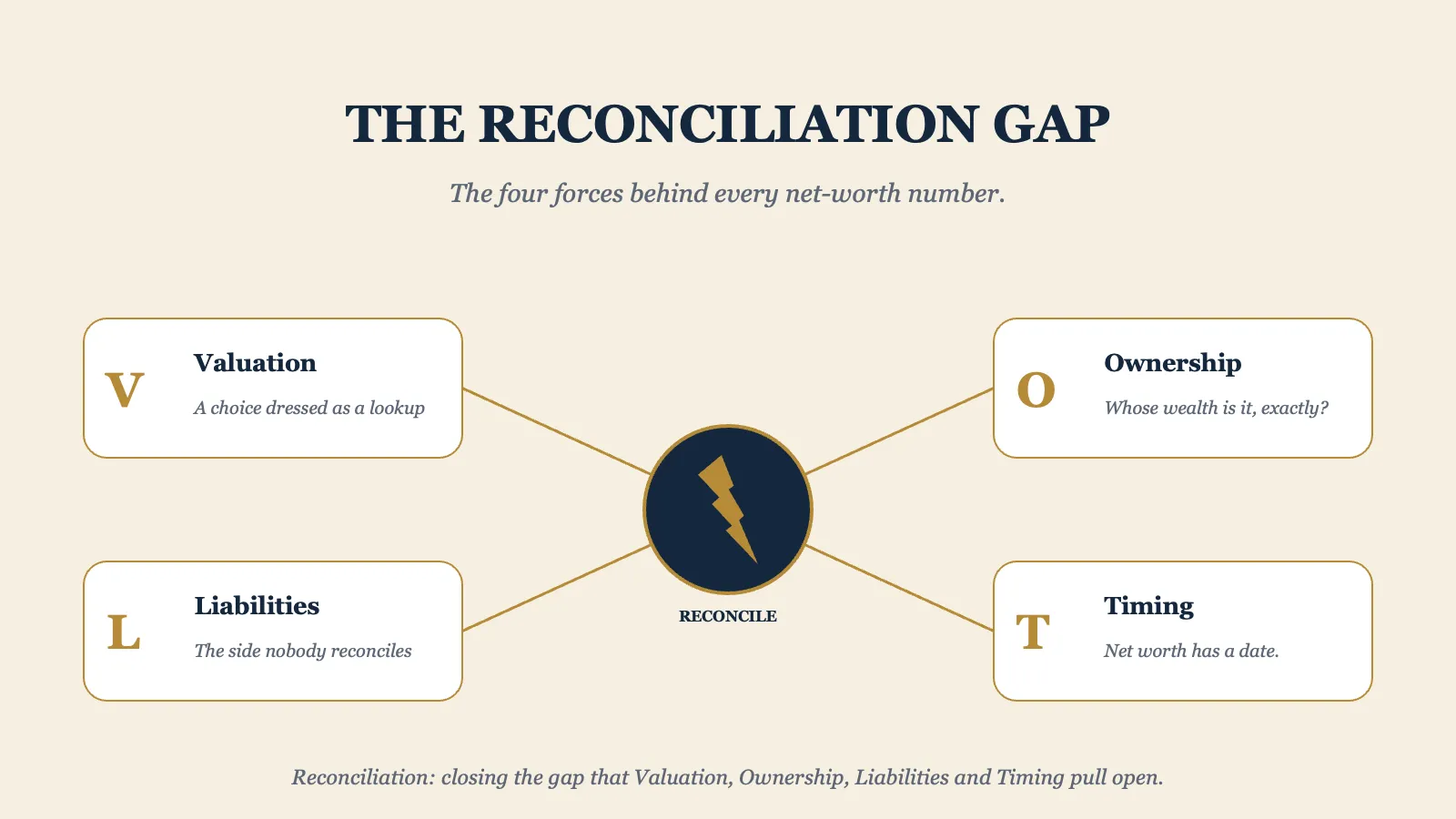
1. Valuation is a choice dressed as a lookup
For listed assets, valuation feels like a fact: the market closed, the price is the price. That’s the easy 40% of a wealthy balance sheet, and it fools people into thinking the whole job is a lookup.
The hard 60% has no closing price.
Arjun’s 19% stake is the classic. The last real transaction, the strategic sale, prices it at ₹61cr. The company has raised since, internally, at a number that implies ₹44cr. Its auditor uses a third figure for the cap table. None of these is the value; they’re three defensible answers, and which one you pick swings the net worth by ₹17cr. People reach for the highest and call it conservative because they didn’t use the dream number.
Real estate is worse, because there’s no transaction at all — only opinions. The same office can sit at the circle rate, the broker’s untested “market”, the yield-implied value, or whatever a paid report needed it to be. I’ve watched one commercial property show up at ₹22cr in a loan file and ₹31cr in an estate plan from the same year — same family, no sense of contradiction — because the two papers were built for two purposes and never met on one page.
Private funds drift quietly. An AIF marks its holdings once a quarter, often reported weeks late, so a “current” net worth built in June leans on a March mark that was itself valuing private companies on December numbers. Reported to two decimals. Six to nine months stale, and labelled today.
Valuation is an input you choose, and most people don’t know they’re choosing. A net worth is only as solid as its softest mark — and the soft marks are the biggest lines.
2. Whose wealth is it, exactly?
The second source is the question that sounds trivial and isn’t: what counts as mine?
Arjun’s wife’s portfolio was funded entirely from his exit but sits in her name. His? For a bank stress-testing his guarantee, yes. For her, legally, no. For the taxman, the income may be clubbed back to him under Section 64 while the corpus stays hers. Three institutions, three answers about the same ₹9cr, each right in its own frame.
Then the HUF that most wealthy Hindu families have and have stopped thinking about. It owns something — a property, a block of shares — that belongs to the family as a unit, not to any one person. When the patriarch states “his” net worth he throws it in by reflex, because he controls it. Legally his share is a fraction, and on his death it doesn’t pass under his will at all.
There is no correct boundary, only one you chose on purpose versus one you drifted into. A net worth for a lender is what they can reach. For an estate plan, what passes under your will. For your own clarity, what you actually control. Three numbers, same person, same day. Almost everyone has drifted, and treats the three as one.
3. Net worth has a date. Your sources don’t share it.
A net worth is a snapshot, and a snapshot has a timestamp. The inputs are photographs taken on different days, stitched into one frame and sold as a single instant.
The demat is live to this morning. The PMS statement is last month’s. The AIF account is last quarter’s, late. The unlisted mark is eighteen months old. The real-estate figure is from a 2024 valuation nobody refreshed. Assemble these into “my net worth today” and you’ve built a composite that matches no actual day — a collage in the clothes of a photograph.
This bites exactly when it matters. You commit to a ₹15cr deal believing you’re sitting on a cushion, but the cushion was measured at four different times, and two of its biggest pieces have moved since. The number felt current. Almost none of it was.
A real net worth needs one as-of date, with every input dragged honestly to it or flagged stale. The date is the first casualty of the wave of the hand.
4. The liability side is the one nobody reconciles
We obsess over what we own and barely track what we owe — which is odd, because debts are the more knowable half. They have contracts and counterparties. They still hide.
The loan against property, taken for working capital, “almost paid off” (₹3.1cr outstanding, not the ₹1cr in memory). The personal guarantee on the company’s borrowing — on no statement anywhere, and a very real claim on the personal balance sheet the day the business stumbles. The unfunded AIF commitment: ₹14cr promised, ₹6cr drawn, ₹8cr still owed on a schedule you don’t control — money with a first claim on liquidity you’ve mentally already spent.
Pledged shares are the sharpest. The block shows up as an asset at full value, your name on it. It’s also collateral, so part of it isn’t yours to sell, and in a margin event isn’t yours at all. Full weight on the asset side, nothing on the liability side.
Net worth is assets minus liabilities. We reconcile the first term loosely and the second almost never, then subtract one soft number from another and call the answer hard.
What a defensible number takes
Not a better dashboard. A dashboard shows you a number; it doesn’t defend one. What you need is the thing accountants worked out five centuries ago and wealthtech keeps skipping: a ledger. Every figure tied to an independent source. Every asset carrying one chosen valuation basis, written next to it. Every holding with an owner and an as-of date. Assets and liabilities as two views of the same events, not two lists kept by two people.
The test is simple and brutal: can you produce the trail without three days and a phone call? For each line — what it is, who owns it, the value and the basis you chose, the source, the date. When that trail exists, the number stops being an opinion. A fact is just an opinion that has survived being checked.
The number that called
Arjun signed the form. The figure felt honest, and he forgot about it.
He had spent his forty minutes on the exciting question — what the 19% was worth. ₹61cr or ₹44cr, the strategic’s price or the down-round. That number never moved. The stake just sat there, exactly as uncertain as the day he signed, hurting no one.
The number that moved was the boring one. That same quarter, the ₹8cr he still owed on the AIFs got called — eleven days’ notice, a schedule he hadn’t set — in the same fortnight he wired the capital his new fund needed. He had treated the ₹8cr as money he had. It was money he owed. For a week and a half, a man worth nine figures on paper was on the phone arranging a bridge loan against the very Bangalore office he hadn’t known how to value.
He had agonised over what he was worth. He never once asked what he owed. That was the number that called.
The Monday test
You don’t need to reconcile the whole balance sheet this week. You need to feel the gap once, on purpose.
Take the net worth in your head — the dinner-party number — and write it down. Now take your three largest non-listed assets and, for each, write the value and the basis you just used. Then write the most defensible alternative basis. Add up how far the number can honestly move. And while you’re there, write down every rupee you’ve committed but not yet paid.
For most families that range runs from a crore at the bottom to an uncomfortable double-digit figure at the top. That range — not the midpoint you’ll want to settle on — is the honest answer to what you’re worth. The midpoint is the opinion. The range is the fact.
The gap between the number you say and the number you could defend has been there the whole time. You just hadn’t asked the question sharply enough to make it show.